Academic Planning and Activities

Academic Planning and Activities

Curriculum Design and Development

  • Integration of interdisciplinary courses
  • Regular curriculum revisions to align with industry trends and accreditation guidelines (e.g.NBA, NAAC).
  • Inclusion of project-based and experiential learning modules.


Research and Innovation Initiatives

  • Establishing research groups for emerging fields like Robotics, Machine Learning, and Sustainable Engineering.
  • Collaboration with industry for funded research projects and internships.
  • Organizing hackathons, ideation contests, and innovation challenges.


Laboratory and Infrastructure Development

  • Upgrading labs with advanced tools like Cadence, NetSim
  • Setting up centers of excellence for specialized fields like Embedded System, VLSI and IoT
  • Promoting virtual labs and remote experimentation for online learners.


Comprehensive Mentorship Program

  • Each student is assigned a faculty mentor to provide personalized guidance in academics, career planning, and personal development.
  • Regular mentorship meetings ensure continuous tracking of student progress and timely intervention for challenges.
  • 1:15 ratio is maintained while assigning faculty to each student batch.


Class Advisors (Teachers)

  • Every class has a designated class teacher who monitors academic performance, attendance, and overall well-being.
  • Class Teachers collaborate with students to set academic and career goals while ensuring compliance with institutional requirements.
  • For A.Y.2024-2025 following class teachers assigned,
  1. FY B.Tech – Dr R. S. Gaikwad
  2. Y.B.Tech – Dr. S. V. Vanmore
  3. Y.B.Tech – Mr. R. G. Mevekari
  4. Final Year B.Tech – Mr. S. K. Parchandekar


Departmental Committees

  • Board of Studies (BoS): The BoS is the primary academic advisory committee of a department in an educational institution. It is responsible for designing, reviewing, and updating the curriculum and syllabus for various courses to keep pace with academic and industry developments. It ensures academic standards and the relevance of teaching, learning, and evaluation processes. Typically includes departmental faculty, subject experts from academia and industry, and sometimes alumni and student representatives. It makes recommendations on teaching methods, reference materials, and academic infrastructure. Usually meets once or twice a year or as needed to revise or develop academic policies and programs. Its suggestions are forwarded to the Academic Council for final approval and implementation.
  • Department Advisory Board (DAB)” The DAB provides strategic guidance to the department for its long-term growth and alignment with industry and societal needs. It typically includes senior faculty members, industry experts, alumni, and sometimes representatives from academia, research organizations, and regulatory bodies. It periodically reviews and advises on the department’s vision, mission, Program Educational Objectives (PEOs), and outcomes. Offers input on curriculum development to ensure alignment with current industry practices and future trends. It acts as a platform to incorporate feedback from stakeholders like employers, alumni, and professional bodies into academic planning. Suggests measures to enhance students’ industry-readiness, soft skills, and employability. It plays a crucial role in supporting the department for accreditations like NBA by reviewing and validating PEOs, PSOs, and outcome attainment.
  • The PhD Progress and Evaluation Committee is responsible for monitoring and guiding the progress of research scholars to ensure the quality and timely completion of research work.


Program Delivery with Emphasis on Experiential Learning:

  • Focuses on engaging students actively in the learning process through real-world experiences rather than passive content delivery.
  • Regular practical labs, simulation-based exercises, and prototyping activities help reinforce theoretical concepts.
  • Students work on real-time projects, mini-projects, and capstone projects to apply classroom knowledge to solve practical problems.


Projects and Mini-Projects

  • Students undertake mini-projects in fifth and sixth semesters and major projects in final year, encouraging application-based learning and research problem statements.
  • Projects often focus on solving real-world problems, with themes such as Smart Cities, E-Healthcare, and Green Computing.
  • Organizing project showcases and hackathons to promote innovation and teamwork.
  • Mini Project and mega project guides are assigned to each group to evaluate student progress.


Industry Visits and Internships

  • Regular industrial visits to top IT/core companies, startups, and research centers provide students with practical exposure to organizational workflows and cutting-edge technologies.
  • Internship opportunities during semester breaks enable students to gain hands-on experience in real-world projects and applications.

Department Symposia / Conference

International Conference

The department organizes conference to enrich the knowledge of students. This provides a platform for both the faculty and students to share their knowledge and to hold discussion with eminent people from both academia and industry and also with their peers. These events help the students to acquire different soft skills.          

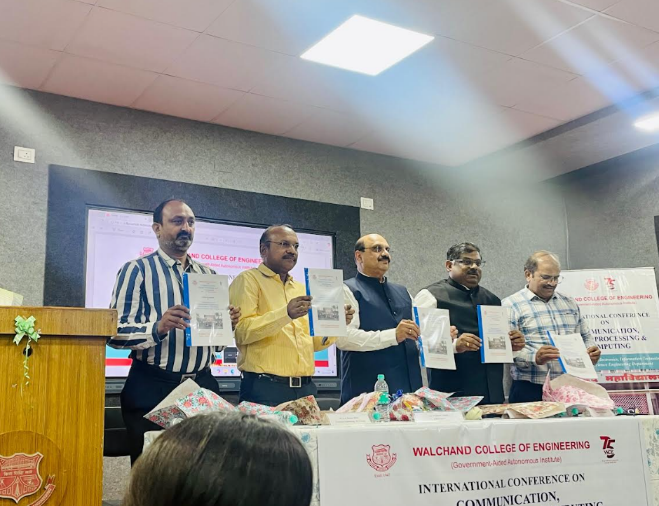
International Conference on Communication, Image Processing and Computing ICCIPC 2025 was conducted on 10th & 11th March 2025. The conference provided a cross disciplinary venue for researchers, academia and industry practitioners to present their state-of-art research work on a wide spectrum of domains like Machine Intelligence, Modern Technologies & Automation, Green Emerging Technologies for smarter and Intelligent World to exchange ideas and explore new avenues of collaborations

International Conference Communication, Image Processing and Computing (ICCIPC-2025)

Department of Electronics Engineering has conducted a national conference on Communication and Image Processing NCCIPC-2023 on 15th, 16th December 2023. The conference provided a common forum for deliberations, sharing of recent trends, advancements and research in the area of Computer Science. This conference was a very good platform for academia, researchers and technologists to discuss and present recent advances and research outcomes. We received technical papers on, domains like Image processing, Big data analytics, Machine learning, IoT, Network security, Cloud computing, Data Mining, Blockchain. All papers presented will be published in the “International Journal of Computing & Information Science”, a UGC approved Journal.
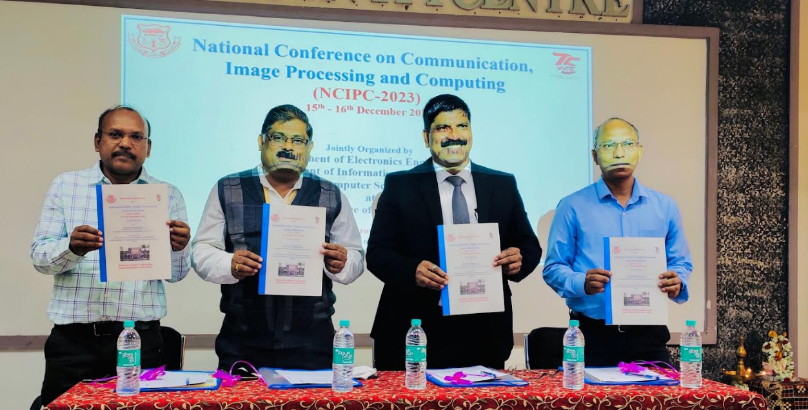
National Conference on Communication and Image Processing (NCCIP-2023)
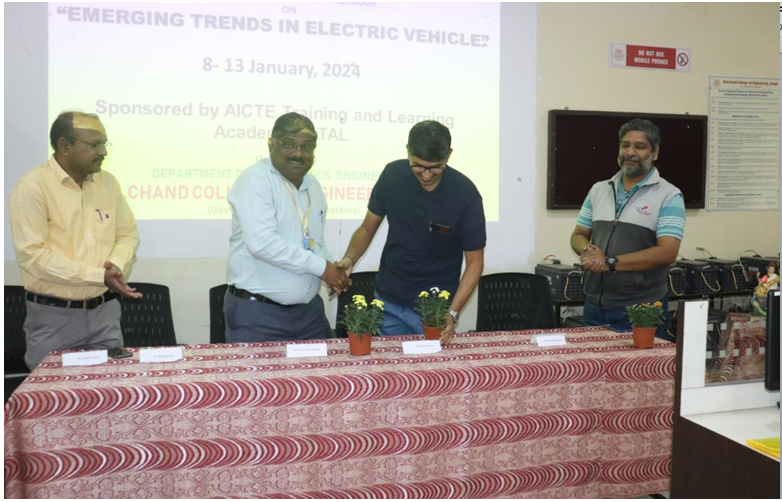
One Week Faculty development program on “Emerging Trends in EV” sponsored by ATAL organized by Department from 8-13th January 2024

Faculty Achievements:

The department takes pride in the remarkable academic and research contributions made by its faculty members during the academic year 2024–25. These include high-impact journal publications, book chapters, international conference presentations, and innovative patent filings. Such achievements reflect the department’s commitment to research excellence, innovation, and knowledge dissemination at both national and international levels.

Patent and Copyright Filings

  • Mrs. D. R. Chavan filed a patent titled “AI-Powered Smart Appliance Monitor”, Application No. 422387-001, on 5th July 2024, which was published on 11th September 2024.
  • Dr. R. S. Gaikwad filed a patent titled “Real-Time Sign Language Recognition and Sentence Generation with Adaptive User Profiling and Multi-Language Support”, Application No. 202421079565, on 6th December 2024.
  • Dr. R. S. Gaikwad also filed a copyright titled “Real-time Sign Language Recognition of Words and Sentence Generation using Artificial Intelligence”, Application No. 38817/2024-CO/SW, on 10th December 2024.
    The copyright was granted on 16th May 2025.
  • Dr. S. V. Vanmore filed a patent titled “Cloud Data Storage Performance Analysis Using Blockchain”, Application No. 202421053169, on 11th July 2024.
    It was published on 2nd August 2024.
  • Ms. S. U. Patil filed a patent titled “Electric Power Device for Aircraft”, Application No. 447720-001, on 11th February 2025
Search